
Stewardship leadership for founders means holding the business in trust, for the people doing the work and for whoever comes after them, rather than treating it as a personal asset to draw down. It worked for me. My last few years in corporate were the best of my career, both in what I earned and in what my group delivered. I didn't get there by tightening anything. I got there by spending most of my attention on what my team needed in order to get better: training budget, air cover on bad projects, two promotions I had to go argue for in a room where nobody wanted to hear it. The results followed the development, in that order.
I didn't have a word for it then. The word is stewardship, and now that I'm the one signing the checks, I'd like to know whether it's a style I grew into or simply the better way to run a company.
I'm not sure it's innate, and I don't think I invented it. The women founders I know mostly built stewardship as a correction, after a decade of being managed by someone who didn't practice it and a quiet decision to run things differently the day they got the chance. Values-led leadership gets described as a temperament women happen to have. For the ones I know, it's closer to a lesson learned the hard way.
What stewardship leadership actually means, beyond “being a nice boss”
EBSCO's research primer on stewardship theory describes executives as responsible guardians of the organizations they lead, acting in the best interests of shareholders and stakeholders rather than out of self-interest. MentorCliq's explainer puts it more plainly: in traditional leadership the team serves the leader, and in steward leadership the leader is the caretaker and guide. That's the definition I'd stand on.
Leadership Circle (2026) adds the part that actually costs money: stewardship means providing the tools, training and support people need to succeed instead of asking what you can extract from them, and treating leadership as a temporary trust over resources that belong to a larger collective.
Why stewardship leadership fits a 1099 workforce better than command-and-control does
ADP Research's 2025 analysis of 2024 payroll data found that 27% of all jobs held in 2024 were gig or contingent work, though in a typical month it was closer to one worker in ten. For a small business, that means the question of how you treat people who don't technically report to you is no longer an edge case at the margins of your org chart. It's most of your hiring conversation, mine included.
ADP also found that independent contractors tend to sit in high-skill, high-autonomy, premium-pay roles, while short-term W-2 temp workers sit in lower-wage, high-turnover jobs. Two completely different labor markets, one word covering both. So when the gig economy gets sold as flexibility, it's worth asking which market you mean: the premium contractor who chose it, or the temp worker absorbing the risk someone else shed. What gets shed is concrete: a 1099 worker gets no payroll withholding and no health or retirement benefits, so the costs the business skips land on her. Stewardship with a contract team is the refusal to pretend otherwise: scope honestly, pay the real rate, pay fast, and classify people correctly even when the other way is cheaper.
Blanchard's 2025 HR/L&D Trends Survey, drawn from more than 900 leadership, learning and talent professionals, found talent still scarce and organizations asking for leaders who are empathetic and able to adapt. Great Place To Work's 2025 trend report notes that many of the trends of the post-pandemic era are being reversed. You can see it in the return-to-office mandates and the quiet march back toward control. The traditional workforce has dissolved, and while some companies are trying to rebuild the old one, what they reconstruct is indistinguishable from the pre-pandemic, pre-AI office. Small businesses are where it's still fully within one person's power to decide.
Which industries benefit most from stewardship leadership, and where it strains
Food service has some of the clearest evidence. A 2026 Liberty University doctoral dissertation surveyed 80 employees of full-service small restaurants in Hawaii and found that servant leadership, stewardship's close cousin, went with higher job satisfaction and lower intention to quit. It shows a link rather than proof, but it's one of the few studies that isolates small business rather than enterprise. Nation's Restaurant News columnist Jim Sullivan made the operator's version of the case years earlier: low-turnover foodservice companies practice reciprocal caring, and “return on retention” may be as significant a number as ROI.
Anywhere replacing a person is slow and expensive, from restaurants to salons to home services to clinics to trades, the math favors stewardship before anyone's feelings enter the room.
Where it strains: genuinely seasonal or project-bound work, where the job ends and pretending otherwise is its own form of dishonesty. And emergencies, where somebody has to make the call in ninety seconds. Stewardship describes who you're accountable to. It doesn't require that every decision go to a vote.
The real strain is financial. If your margin only clears because someone on your team is underpaid, stewardship won't fix the margin. It will just stop you from pretending you didn't know.
Three ways to practice stewardship leadership this week
Ask one person what they're trying to get better at, then put money or hours behind the answer. A $200 course and four protected hours counts. Leadership Circle's framing is the test: did you provide a tool, or did you provide encouragement?
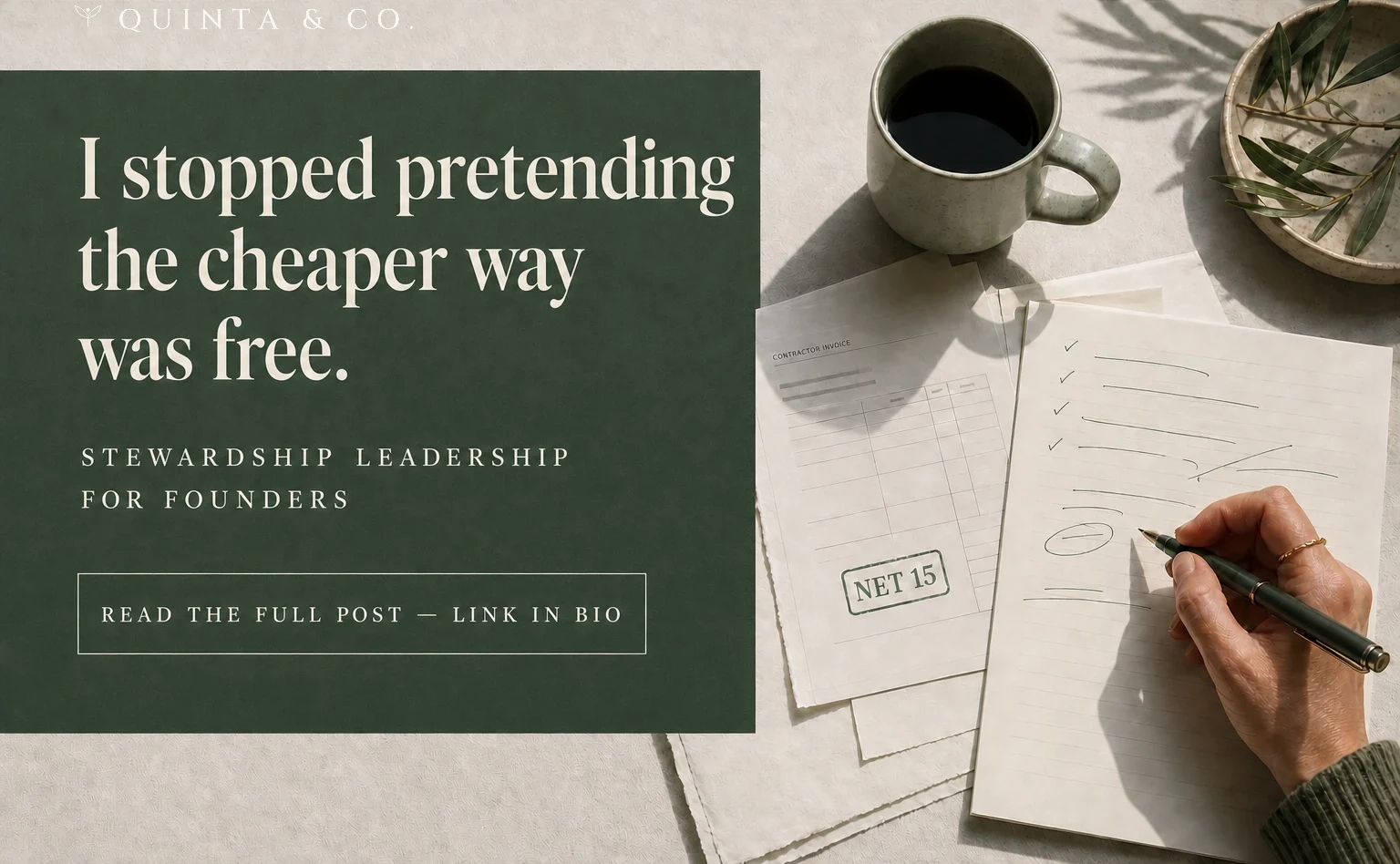
Change your payment terms. Move contractors to net-15 and pay the invoice the day it lands when cash allows. No leadership philosophy survives a 60-day payable.
Share the tooling instead of hoarding it. If AI is quietly doing a chunk of your work, teach it to the people doing the rest rather than using it as a private reason to pay someone less. That's the whole argument for where to start with AI as a shared practice: the tools are cheap, and the advantage was never supposed to be secrecy.
Stewardship leadership for founders isn't a personality you're born with. It's a sequence of ordinary decisions about who gets the tools, who gets paid first, and who gets developed on your dime.
So to answer the question I opened with: I don't know that I evolved so much as I stopped pretending the cheaper way was free. It works wherever you intend to keep people, and it gets expensive wherever you don't. Plus, it just feels good to help others succeed.
If you want to work through one of those decisions out loud with other women running small businesses, Coffee with Quinta is free and monthly, and we build one small working thing in an hour.
Sources
- The Gig Economy: A Tale of Two Labor Markets — ADP Research (Łukasz Below), November 2025.
- Stewardship Theory — EBSCO Research Starters (Janine Ungvarsky), 2020.
- Stewardship Leadership — Leadership Circle (Katie Sullivan Porter), June 2026.
- Steward Leadership — MentorCliq, 2023.
- 2025 HR/L&D Trends Survey — Blanchard, December 2024.
- 7 Workplace Trends to Watch for 2025 — Great Place To Work (Ted Kitterman), January 2025.
- Examining the Relationship Between Servant Leadership, Job Satisfaction, and Turnover Intention in the Restaurant Industry — Vincent T. Domingo, Liberty University doctoral dissertation, April 2026.
- Best Practices in Restaurant Employee Retention — Jim Sullivan, Nation's Restaurant News (opinion column), April 2015.