
Most women who tell me they haven't tried AI say one of three things.
"I'm not technical." "It's too expensive." "I don't have time to learn it."
I've heard all three enough times that I can usually guess which one is coming before the sentence finishes. And here's what I want you to know before we go any further: none of the three is really about AI. They're about starting. Which is a different problem, and a much older one.
So let's not talk about understanding AI. You don't need to understand it. You need to know where to begin.
The objections are real. The data says something a little different.
Start with the numbers, because they cut against the story most owners tell themselves.
The Reimagine Main Street survey with PayPal (June 2025, about 1,000 businesses making $25K–$5M) found that 51% of small businesses are "Explorers" — they're playing with tools but haven't committed. The word I want you to notice is Explorers, not skeptics. When asked why they haven't gone further, 74% said they'd adopt with clearer proof it was worth it, 73% wanted easier tools, and the top request across every group was plain, practical training.
That's not a room full of people who think AI is a scam. That's a room full of people waiting for someone to show them the useful part.
The "I'm not technical" objection deserves its own look. The SBA Office of Advocacy found in September 2025 that among the very smallest firms — under five employees — the main reason non-adopters stay out isn't cost and isn't complexity. It's that 82% believe AI simply doesn't apply to their business. The SBA calls this an education gap, not a real limit. FactoryJet's 2026 analysis puts it more bluntly: it's "a failure of relevance." The tools that get the press are built for office knowledge workers, so a florist or a bookkeeper or a glass sub looks at all of it and reasonably thinks, not for me.
It's for you. It's just been badly introduced.
As for cost: the JP Morgan Chase Institute tracked actual payments in business bank accounts and found that most of the recent growth came from tools priced at $20–$30 a month. Not enterprise contracts. The price of a couple of coffees.
Chasing the flashy promises is how people waste money and quit.
There's a version of AI marketing that promises to run your business for you. Ignore it. That version is where owners lose money and lose faith.
The Forbes Technology Council put the real risk in one line worth taping to your monitor: "validating unreliable AI outputs often costs more than doing the work directly." If you hand a tool your whole job and then spend your day checking whether it lied to you, you haven't saved anything. You've added a shift.
The Simply Business 2026 outlook shows owners already know this in their bones. Adoption is high for low-stakes creative work — 51% use it for research and brainstorming, 44% for content — and it drops sharply the moment real money is on the line. Only 10% would let AI near a business insurance decision. That instinct is correct. Keep it.
The distinction that matters isn't hype versus real. It's general versus task-level. The theStacc compilation of 2026 stats found that the businesses gaining the most from AI aren't the ones spending the most — they're the ones who matched a tool to a specific task instead of buying "AI" like a new software suite. Same report: owners save around 5.4–6.8 hours a week, but on administrative work, not on running the whole show.
Match the tool to the task. That's the whole game.
Where a non-technical owner actually starts.
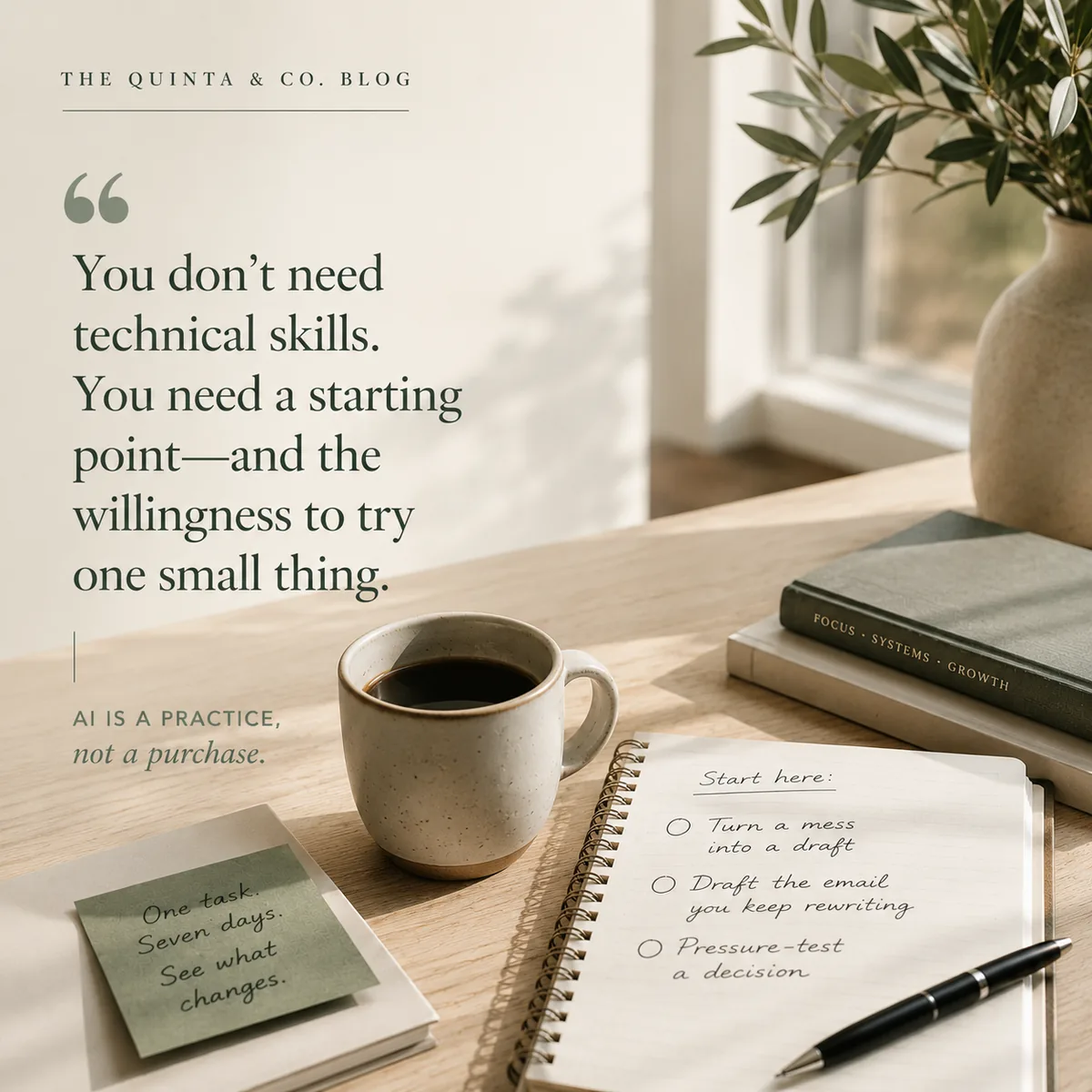
Here's what I put in front of people when they've never touched a tool and don't want a lecture. Three tasks. All low-stakes. All things you already do.
Turn a mess into a draft. You have a voice memo, a page of scattered notes, or a wall of texts about a project. Paste it in and ask for a clean, organized version. You're not asking the tool to think for you. You're asking it to do the sorting you'd do anyway, faster. This is content creation and research synthesis, the two use cases Techloy found deliver the most consistent small-business ROI.
Draft the email you keep rewriting. The follow-up. The polite decline. The "here's where the project stands" update to a client. You'll edit it — you should edit it, it won't sound like you yet — but starting from a draft beats starting from a blank screen at 9pm.
Pressure-test a decision. This one surprises people. Before you make a call, ask the tool to argue the other side. "Here's what I'm thinking. What am I missing?" It won't decide for you. It'll surface the three questions you were too close to see.
Notice what all three have in common. Techloy's structural finding is that AI works best when it augments an existing process rather than replacing it or requiring a brand-new one. You're not rebuilding your business. You're handing off the first, roughest 30% of a task you already own.
If you want a way to begin without buying anything, pick one of those three and try it for a week. That's it. One task, seven days. You'll learn more from that than from any course.
What separates the owners who get results.
It isn't technical skill. I want to be very clear about that, because "I'm not technical" is doing so much heavy lifting in this conversation.
What separates them is closer to temperament. The owners who get real results start small, stay honestly skeptical of the flashy promises, and keep only what actually works. Digital Applied's 2026 guide describes the pattern the same way: start with one high-value area, measure for 90 days, then expand — rather than switching everything on at once.
A production builder and a luxury custom builder will land in different places, and both are right. If you're running a high-volume, tight-margin operation, your first useful task is probably something repetitive that eats your admin hours. If you're doing a handful of complex, relationship-heavy projects a year, it might be pressure-testing a proposal or cleaning up field notes into a client-ready update. Different contexts, different starting tasks. The method is the same: match tool to task, keep what earns its keep, drop the rest without guilt.
The fastest way to build that judgment isn't reading more articles like this one. It's watching someone a few steps ahead of you show their actual screen — what they tried, what broke, what they quietly abandoned.
That's what we did at the HER Texas House panel. Practitioners, not gurus, talking about where they started and what they'd skip if they had it to do again. Come sit in. Bring the one task you've been avoiding. You'll leave with somewhere to begin — which, as it turns out, was the whole thing you needed all along.
AI is a practice, not a purchase. You don't have to understand it. You just have to show up and start.
Sources
- Simply Business 2026 Small Business AI Outlook: Active Users Stay Selective — Simply Business, 2026 Small Business AI Outlook (survey of 1,047 U.S. small business owners, Q4 2025–Q1 2026), 2026.
- JP Morgan Chase Institute: Transaction-Based AI Adoption Data Shows 17.7% of SMBs Consistently Paying for AI by End of 2025 — JP Morgan Chase Institute, "Understanding the Use of AI Among Small Businesses" (Small Business in the Age of AI, Report 1), April 2026.
- SBA Office of Advocacy Research Spotlight: Small Firms Closing the AI Gap — U.S. Small Business Administration, Office of Advocacy, "AI in Business: Small Firms Closing In" (Research Spotlight), September 2025.
- Digital Applied Guide: 68% Use AI, 77% Have No Formal Policy — The Strategy Gap — Digital Applied, "Small Business AI Adoption: 68% Use It, Most Wing It" (2026 adoption guide), February 2026.
- Reimagine Main Street / PayPal Survey: 51% of SMBs Are "Explorers" — Stuck, Not Skeptical — Reimagine Main Street (Public Private Strategies Institute) in partnership with PayPal (June 10, 2025, ~1,000 businesses, $25K–$5M revenue), June 2025.
- theStacc 52-Stat Compilation: Firms Gaining Most Are Task-Matchers, Not Big Spenders — theStacc, "Small Business AI Adoption: 52 Stats (2026)," aggregating JPMorgan Chase Institute, U.S. Census Bureau, OECD, SBA, Salesforce, HubSpot, and others, May 2026.
- FactoryJet Analysis: The "Perceived Irrelevance" Problem — 77% of Non-Adopters See No Use Case — FactoryJet, "AI Adoption by US Small Businesses 2026: Real Numbers" (citing SBA 2025 and JP Morgan Chase Institute transaction data), June 2026.
- Forbes Technology Council: How to Separate Real AI Value From Hype — Practitioner Tips — Forbes Technology Council, "Separating Real AI Value From Hype: Tech Experts' Tips," February 2026.
- Techloy: What Actually Delivers ROI for Small Business — Customer Comms and Content Creation Lead, Integration Is Key — Techloy, "AI Tools for Small Business: What Actually Delivers ROI Beyond the Hype," February 2026.