
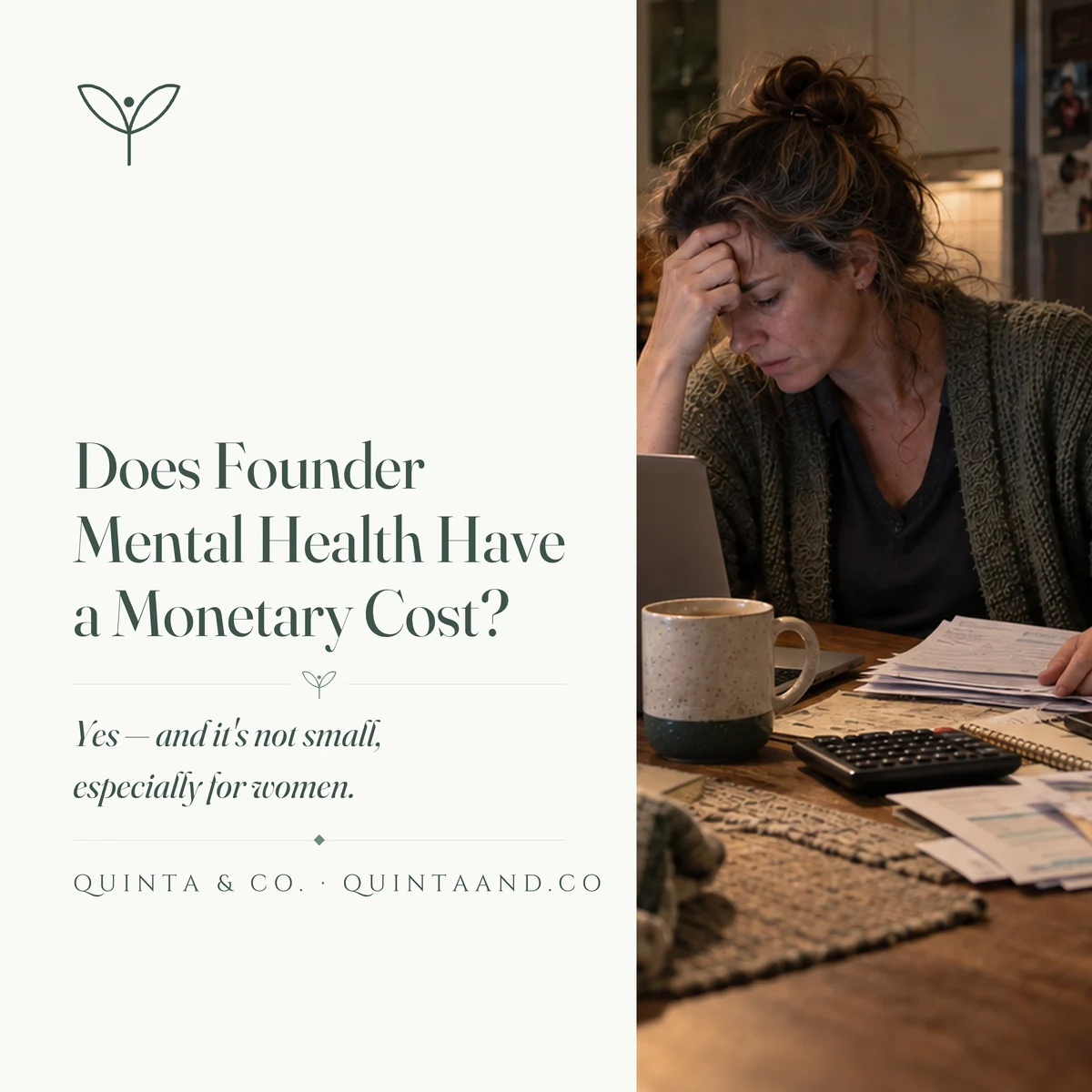
Over the past month or two, the discourse around women's mental health feels like it has been dragged into a harsh light. It gets dissected and analyzed from every angle by news outlets, casual commentators, and internet sleuths alike. The double standard remains predictable and inescapable. We are criticized for overworking, yet labeled disengaged if we step back. We are judged as either absent parents or overbearing ones. And heaven forbid a woman decides to build a business, particularly while raising kids — the immediate reaction is still disbelief and judgment.
Mental illness costs the U.S. economy roughly $282 billion a year, and unresolved depression alone drops productivity 35%. For a woman running her own business, those numbers stop being abstract fast — they show up as the invoice you didn't send and the launch you pushed a month. Women founders report mental health challenges 30% more often than men, and the reasons aren't a mystery and aren't a personal failing. They're financial pressure, caregiving load, and less support, stacked on top of the ordinary strain of running a business.
I want to talk about this openly, because the women in our studio are living it. They show up to learn the foundations, AI and no-code tools, and somewhere in the middle of that, the real thing comes out: I'm tired in a way sleep doesn't fix.
So let's look at the numbers, the gap between women and men founders, what it costs, and where to actually go for help.
What Do the Mental Health Statistics on Women Founders Actually Say?
Start with the baseline. A 2026 survey by The Lonely Entrepreneur, covering 227 founders, men and women, across 46 countries, found that 87.7% of entrepreneurs struggle with at least one mental health issue — anxiety, high stress, financial worry, burnout, and impostor syndrome each hitting more than 30% of people surveyed. Only 18.5% of them knew that mental health resources built specifically for entrepreneurs existed at all.
That's founders generally. Now add the gender layer.
The January Ventures survey of 311 early-stage founders, fielded through 2024 and reported in February 2025, found female founders were 30% more likely than men to report mental health challenges. And the gap in feeling backed by investors was the widest it's been since before the pandemic: 11% of women felt strong VC support, against 22% of men. Nearly 60% of male founders said they felt optimistic about raising capital; only 41% of women did.
A structural problem I ran into while writing this: when you go looking for hard data on women founders and working mothers, much of the "latest" research still dates to 2023 and 2024, and it's genuinely difficult to source. That gap tells you something. A field this underfunded and under-studied is a field where the support women founders need hasn't been built yet, and you can't fix what nobody's measuring.
The pressure isn't imaginary and it isn't evenly distributed. Research published in JAMA Internal Medicine in 2025, from Columbia and the University of Michigan, tracked mothers of children under 18 from 2016 to 2023. The share rating their own mental health as fair or poor rose 63.6%. The share reporting excellent mental health fell from 38% to 26%. And the decline started before the pandemic, across nearly every socioeconomic group they looked at. Working mothers are also 28% more likely to burn out than working fathers, per Maven's analysis of 440,000 working parents. The drivers named are structural — childcare costs, no paid leave, thin flexibility, and the quiet assumption that the caregiving is hers.
What's Actually Different for Women Founders Versus Men?
The difference isn't that women feel more. It's what they're feeling about, and how alone they are with it.
Here's the part that should stop you. The Lonely Entrepreneur data (2026) found that women founders are considerably more likely than men to have a support system for talking openly about mental health — 70.6% versus 52.5%. And the January Ventures survey still found women 30% more likely to report mental health challenges. Different surveys, different rooms, but put them next to each other and the conclusion is hard to avoid: women are building the networks and reporting the strain anyway. Which tells you the load itself is heavier, not that the coping is worse.
A Flourish Ventures study with Endeavor Insight in Brazil found financial stress dominates: 60% of founders named their company's finances as their top external stressor, and 36% named fundraising. The same study found 92% of founders personally know another entrepreneur who has faced mental health challenges, and 54% said mental health is still treated as taboo in their ecosystem. Everyone is in it. Almost nobody says so out loud.
Psychology Today frames the compounding clearly: wage gaps that widen into net worth gaps, dependent-care that eats into earnings and then hands you guilt on top, and less systemic support than male peers get. Their piece names the real stakes — the risk of losing the business, the relationships, or your life. It's something we feel, we know, we've heard, and it bears repeating. I'm not going to soften that.
There's a framing here I got from my colleague Katie Hess, MA, PMP, CIC, who founded Menina Insight Consulting and works with people navigating major life transitions. The more I learn about her approach, the more obvious it is that founders are exactly that population, and nobody treats us like it. We don't call what we do transitions. We call it launching, pivoting, hiring, scaling back, losing the client who was thirty percent of revenue. Every one of those is a life change, and they arrive back to back with no recovery window in between. There's almost no such thing as career counseling for founders, because the assumption is that once you're the boss you've arrived somewhere and the identity questions are settled. They aren't. When Katie surveyed 21 women launching or building businesses, she saw this exact pattern: they weren't just looking for empathy or practical tactics. What they needed was a combination of clarity, support, and structure to cut through the isolation and navigate the uncertainty of where to go next.
If anything, that list gets louder, and the impostor syndrome founders report is as much a symptom of constant transition as it is a confidence problem. Having someone in your corner whose actual expertise is change, rather than strategy or tactics, is a category of support most of us never think to go looking for.
Does Founder Mental Health Have a Dollar Cost? Yes — And It's Not Small
Mental illness costs the U.S. economy roughly $282 billion a year — about 1.7% of annual consumption, or the budget of a major federal department. That figure comes from Columbia Business School's Boaz Abramson, working with Job Boerma at Wisconsin and Aleh Tsyvinski at Yale, and it runs about 30% higher than earlier estimates because they measured how people with mental health conditions actually behave: working, investing, and spending differently, not just missing days. The American Psychiatric Association estimates unresolved depression alone drops productivity 35%, costing organizations $210.5 billion annually.
For a solo founder, that number lands somewhere more concrete than a headline. It's the invoice you didn't send. The launch you pushed a month because you couldn't face it. The client relationship that thinned out because you had nothing left to give it.
A 2025 peer-reviewed study in Small Business Economics found that recovery experiences — actual psychological rest during non-work hours, broken down as detachment, relaxation, mastery and control — are a key determinant of a founder's mental health. Not rest as a reward at the end of a good quarter. Rest as a daily input the business runs on.
My friend Brieanna Lightfoot Smith of B.Light Media has built an entire practice around that finding, and she got there the hard way. She passed out in her car at seven months pregnant, working a full-time job and a part-time job while building her company on the side. Her R.E.S.T. framework came out of that, and the letters are the reason I point women to it: Restore, Energize, Sustain, Track. Half of it is operational. Rest that depends on you feeling like you've earned it, or on the calendar cooperating, is rest that never happens, because the calendar will not cooperate and you will never feel like you've earned it. Building it into the system is the only version that survives a hard quarter.
Your business doesn't have a productivity problem. It has a person who is running out of road. Those are not the same thing, and no automation fixes the second one.
Where Can Women Founders Actually Go for Mental Health Support?
Let's start with the clinical and community options, then I'll point to two resources close to home, here in Dallas.
If you or someone you know is in crisis, call or text 988 to speak to someone. Being a founder is lonely, but you are not alone. You are important and here for a reason.
- NAMI — education, advocacy, and professional-led support groups.
- Talkspace — flexible teletherapy for schedules that don't hold still.
- Headspace — a low-stakes place to start with rest and stress, which the Small Business Economics research suggests actually matters.
- The Anxiety and Depression Association of America (ADAA) — for the two things founders report most.
- Lean In Circles and Ladies Who Launch — peer accountability, run by people who understand the founder-specific version of this.
And two closer to home, both women I know and trust:
Katie Hess, MA, PMP, CIC — Menina Insight Consulting (meninainsight.com). Katie works with people moving through major transitions, which is the whole job description of being a founder even though we never label it that way. If the thing you're carrying is less "I need a therapist" and more "I don't recognize the person running this business and I don't know what I want next," this is the conversation you're looking for.
Brieanna Lightfoot Smith — B.Light Media (blightmedia.co). Brieanna's R.E.S.T. framework treats rest as infrastructure rather than a reward, and she has a free R.E.S.T. assessment that will tell you more in fifteen minutes than another week of pushing through will. Start there.
Peer support isn't a nice-to-have here. But given that women already build support networks and report the strain anyway, more people to talk to isn't the fix on its own. What moves the number is support that actually takes weight off you: someone qualified to help you sort the identity questions, a system that protects your recovery whether or not you feel deserving of it, and a professional when the load is heavier than peers can carry with you.
Some of that weight is practical, and practical weight comes off faster than people expect. If the thing keeping you up is the money — and for 60% of founders, it is — then the fix isn't a mindset. It's knowing where your numbers actually are, and charging enough that the math works. We teach both, in rooms with other women doing the same thing. That's The Practice, and it exists because isolation is the common thread under most of what founders carry alone.
If you want the lowest-stakes version of that room, Coffee with Quinta is free and monthly, and nobody there will ask you to be doing better than you are.
If you're reading this at the end of a long day and the tired isn't the kind sleep fixes, that's information, not a character flaw. Take it as seriously as you'd take a number on your P&L moving the wrong direction, because it is one.
Sources
- 87.7% of Founders Struggle With at Least One Mental Health Issue — and Only 18.5% Know Entrepreneur-Specific Resources Exist — The Lonely Entrepreneur / Founder Reports survey of 227 founders across 46 countries, 2026.
- Female Founders Are 30% More Likely to Report Mental Health Challenges; Only 11% Feel Strong VC Support vs. 22% of Men — January Ventures Annual Founder Survey, 311 early-stage founders, fielded 2024, reported February 2025.
- Mothers Reporting Fair or Poor Mental Health Rose 63.6% Between 2016 and 2023; "Excellent" Fell From 38% to 26% — Trends and Disparities in Maternal Self-Reported Mental and Physical Health, JAMA Internal Medicine (Columbia University and University of Michigan), May 2025.
- Working Mothers Are 28% More Likely to Experience Burnout Symptoms Than Working Fathers — Maven Clinic analysis of 440,000 working parents, including 226,000 mothers, December 2020.
- 60% of Founders Name Company Finances as Their Top External Stressor; 92% Know Another Entrepreneur Who Has Faced Mental Health Challenges — Flourish Ventures with Endeavor Insight, study of high-impact entrepreneurs in Brazil.
- Mental Illness Costs the U.S. Economy $282 Billion Annually — Roughly 1.7% of Annual Consumption — Boaz Abramson (Columbia Business School), Job Boerma (University of Wisconsin) and Aleh Tsyvinski (Yale), The Macroeconomics of Mental Health, 2024.
- Unresolved Depression Drops Productivity 35% and Costs Employers $210.5 Billion a Year — American Psychiatric Association, The Economic Cost of Depression Is Increasing.
- Daily Recovery Experiences Are a Key Determinant of Entrepreneurs' Well-Being and Burnout — Mental Health of Entrepreneurs and Daily Recovery Experiences, Small Business Economics, 2025.