
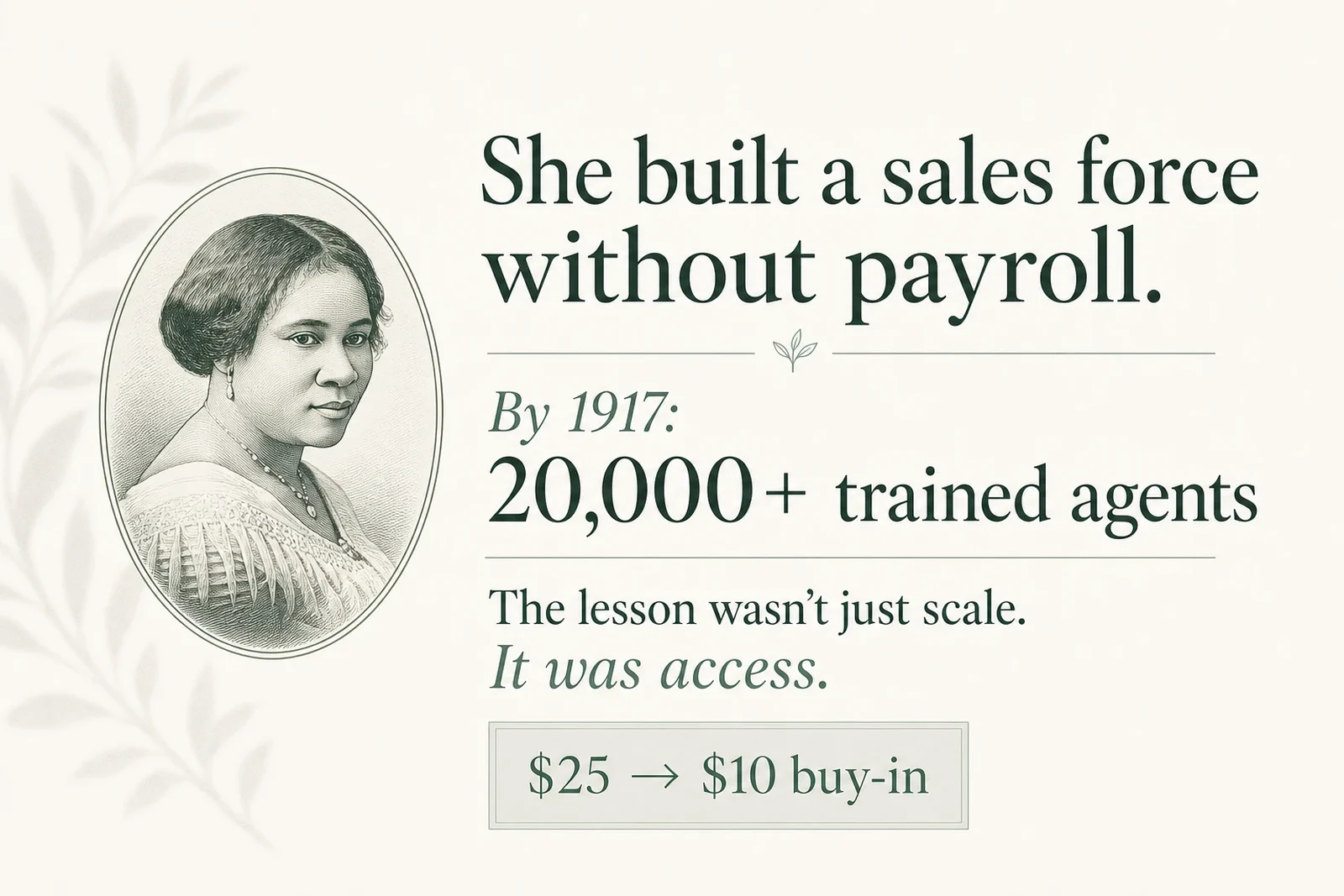
No. Your first hire doesn't have to be an employee — contractor vs employee is a fit question, and the right answer depends on the shape of the work, not on how serious you are about your business. By 1917, Madam C.J. Walker's company had trained more than 20,000 women as sales agents selling her products across the country (Indiana Historical Society / Business Hall of Fame). Not one of them was on traditional payroll.
A practitioner who runs a two-person residential cleaning company told me she'd been “about to hire” for eleven months. She had the demand, and she had a woman in mind. What she didn't have was the number — how many additional houses per week the new person would need to clean before the hire stopped being a bet and started making sense.
Eleven months of “about to” is what a missing number looks like. Nobody hands you a worksheet for this in business school, and the people who sell hiring advice usually sell it alongside a payroll product.
What the 2026 Hiring Numbers Say About Small Business Owners Who Are Stalling
In August 2026, 35% of small business owners had job openings they couldn't fill. By September that eased to 32% — still eight points above the historical average — and 87% of owners who were hiring reported few or no qualified applicants (NFIB, 2026).
The shortage is real. Some of what's showing up in those numbers, though, is owners who aren't yet certain a new person is worth a fixed monthly cost.
Owners are voting with their structures. G&A Partners' 2026 SMB Readiness Report found 39% of small and mid-sized businesses have shifted toward contractors instead of full-time employees, and 77% have delayed or stopped hiring entirely because of economic uncertainty. Robert Half, cited in Xero's 2026 small business hiring guide, reports 45% of small businesses plan to increase contract hiring in the first half of 2026. SHRM finds the same trend at the top: 72% of CEOs expect to use more independent contractors, gig workers, and freelancers over the next twelve months.
Read those together and what you're looking at is small businesses rearranging who carries the risk. If three-quarters of your peers have paused hiring and nearly half are expanding contract work instead, you're in the middle of the pack, and the pack has quietly changed methods. Slowly, companies like Uber, Lyft, Fiverr, TaskRabbit and Upwork have built a gig economy that COVID and now inflation turned into the perfect storm for normalized contract labor. It isn't new. It's just new to our generation.
Madam C.J. Walker Built a 20,000-Person Sales Force Without Payroll
Walker's agents bought product, sold it in their communities, and kept a commission. She trained them, gave them a system, and let the math do the recruiting.
The access piece is the part most people skip. Walker lowered the cost of joining her business from $25 to $10 for women who couldn't afford the normal price, and let them repay her once they could (EBSCO Research Starters). Her full story is worth an evening. Was the lower cost generosity? Maybe. Business sense is the better reason: a woman who can't afford $25 today can still sell product and pay her back in a month, and a woman who never gets in the door sells nothing, forever.
The earnings tell you the model wasn't exploitation dressed up as opportunity. At a time when unskilled white workers earned roughly $11 a week, Walker's agents were making $5 to $15 a day (Henry Louis Gates Jr., Time, 1998). A good day beat a week of wage work.
That only works because the job had a clean, countable outcome: product sold. Nobody had to supervise anybody's hours. Which is exactly the question to bring back to your own business.
Contractor, Commission, or Employee: Match the Method to the Work
Different work wants different structures, and the mistake is picking the structure first and then forcing the job into it.
An employee fits when you control the how. Set hours, your process, your uniform, your standards enforced in real time, ongoing and indefinite work. The cleaning company is the clearest case. If you're training someone on your specific room order and sending her to accounts you own, that's an employee, and the fixed cost is the price of consistency. Payroll is a bill that arrives whether or not you had a good month. Sometimes that's the right bill.
A contractor fits when you're buying a defined outcome with specialized skill. A bookkeeper closing your month. A photographer shooting your spring line. A fractional ops person building you a scheduling system in six weeks. You're buying the deliverable, and how they get there is genuinely their business.
A commission structure fits when the result is countable and the person can increase it. Sales, mostly. Walker's model. It only works if the person has a real opportunity for profit — and a real risk of a slow month — and if you're honest with candidates that the floor is low and the ceiling isn't.
Match the structure to the work, then price it. In that order.
The DOL's 2026 Proposed Rule Makes Contractor Classification Easier to Read
On February 27, 2026, the Department of Labor proposed a rule simplifying how businesses determine employee versus independent contractor status. The SBA's Office of Advocacy put the savings for small businesses at an estimated $2.31 billion over ten years (U.S. Small Business Administration, Office of Advocacy).
The proposed rule replaces the 2024 six-factor test with a five-factor economic reality test and weights two factors as “core”: control over the work, and the worker's opportunity for profit or loss. Those two are the ones to hold your arrangement up against before you write the agreement.
The tradeoff: easier-to-read rules are not a license to call an employee a contractor. If you're setting someone's hours, directing her minute to minute, and she has no way to earn more by working smarter, she's an employee, and misclassification gets expensive in back taxes and penalties, usually at the worst possible moment. The $2.31 billion in estimated savings is mostly the cost of guessing, removed. It isn't permission.
Run your arrangement past a CPA or an employment attorney before the first invoice. One hour of their time is cheaper than a reclassification.
How to Price Your First Hire as Shared Risk Before You Feel Ready
Try this for a week. Write down the single outcome you'd be paying for — houses cleaned, orders shipped, consults booked, invoices reconciled. Put a dollar figure on one unit of it. Then calculate how many units the person has to produce before the arrangement pays for itself, and decide who carries the gap between zero and that number.
If you carry the whole gap, you want an employee and you want to be sure. If the person can carry part of it in exchange for upside, you have a contractor or commission conversation, and you can start smaller, sooner, with less riding on being right.
That's the whole exercise. It's the kind of practical answer that doesn't show up in business school, and it's what we work through together in The Foundations — bring your actual numbers, not a hypothetical.
If the contractor vs employee question for your first hire has been sitting open on your desk for months, come to a free Coffee with Quinta and put the real numbers on the table. Bring last quarter's revenue and your actual calendar. That's enough to find the number.
Sources
- Small Business Hiring Slows in September 2026 — NFIB Jobs Report (Sept. 2026), October 2026.
- Nearly 40% of SMBs Shift Toward Contractors — G&A Partners, 2026 SMB Readiness Report, 2026.
- 45% of Small Businesses Plan to Increase Contract Hiring — Xero Small Business Hiring Trends Guide (citing Robert Half), 2026.
- 72% of CEOs Expect More Use of Contractors and Gig Workers — Fountain, “9 Contingent Workforce Trends” (citing SHRM), October 2026.
- DOL Proposes 2026 Rule Easing Independent Contractor Classification — U.S. Small Business Administration, Office of Advocacy, March 2026.
- The DOL's Two-Core-Factor Test for Contractor vs. Employee Status — Xero, coverage of the DOL proposed rule, 2026.
- Madam Walker Trained Over 20,000 Sales Agents by 1917 — HistoryHit / Indiana Historical Society / Business Hall of Fame.
- Walker Lowered Her Agent Buy-In Fee From $25 to $10 — EBSCO Research Starters: Madam C.J. Walker.
- Walker Agents Earned Commissions Far Above Standard Wages — Business Hall of Fame / Synchrony Bank (citing Henry Louis Gates Jr., Time, 1998).